

Quick answer
Most guided routes on Sólheimajökull are rated easy to moderate: roughly 2–3 hours total, under 100 metres of cumulative ascent, on crampons over uneven ice. The approach path from the car park to the ice edge has lengthened considerably as the glacier retreats, so the walk-in is now the longest flat section. Deeper crevasse routes are graded harder and require prior experience.
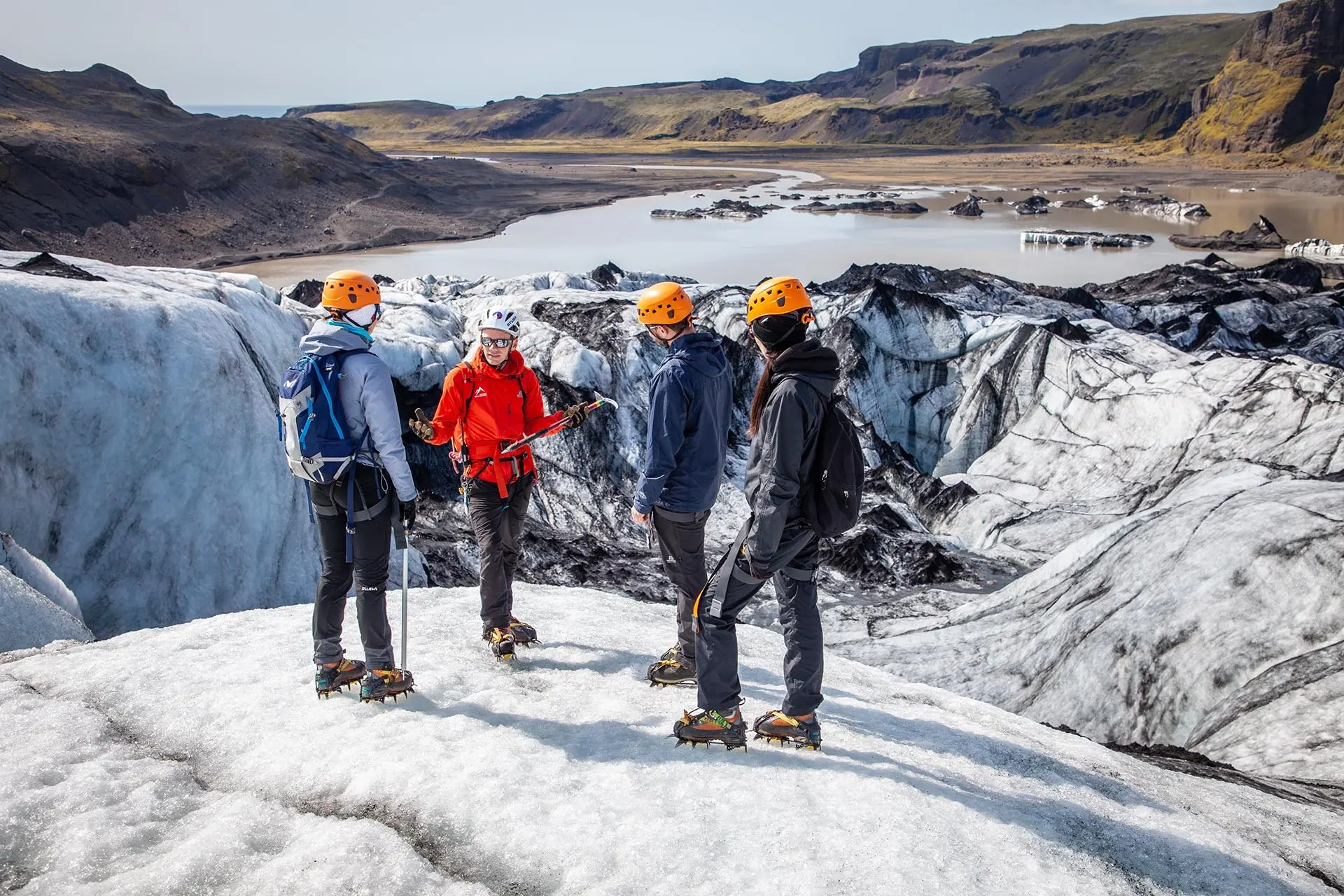
Sólheimajökull has retreated by more than a kilometre since the turn of the century, and that single fact reshapes the whole question of sólheimajökull glacier hike difficulty. Where guides once stepped onto ice within minutes of the car park, groups now cover a lengthening gravel and moraine approach beside a proglacial lagoon before crampons come out. The terrain there is loose, occasionally muddy, and unremarkable — but it is where most of the walking distance now lives, and it is the part visitors forget to account for. Once on the ice, the character of the outlet glacier changes entirely. This is a Mýrdalsjökull tongue, low-lying and heavily fissured, with ash bands from Katla and Eyjafjallajökull layered into the surface as dark ribbons. The difficulty is not gradient. Sólheimajökull rises gently for most of its accessible lower section; what taxes people is the constant micro-adjustment of walking in crampons over ridged, ablated ice, stepping around meltwater channels and moulins, and holding an ice axe correctly for two hours. Ankles and hip flexors feel it more than lungs do. Anyone comfortable on a rocky coastal footpath will manage; anyone who has never worn traction spikes should expect the first twenty minutes to feel awkward before the rhythm arrives. Grading language matters here, and a jökulganga in Iceland is never a solo undertaking on a live glacier. Operators publish route levels precisely because the ice moves and the safe corridor shifts week to week; the flagged path a guide follows in August 2026 will not be the same line walked in February. That is the core of any honest sólheimajökull glacier hike difficulty assessment — the physical demand is modest and the hazard management is not, and the second is what a certified guide is actually being paid for. Crevasses near the terminus are often narrow, dark, and poorly visible against ash cover. Use this the practical way. The site is free and accessible around the clock at Road 221, but arriving between 08:00 and 11:00 gives quieter ice, better footing before afternoon melt softens the surface, and a guide with time to answer questions. Match the route grade to honest self-assessment rather than ambition, and the day works.
“The physical demand of walking Sólheimajökull is modest; the hazard management is not, and that is what a certified guide is actually being paid for.”
Sólheimajökull Glacier Hike Difficulty: Easy vs. Moderate Tours Compared
Visitors to Sólheimajökull must decide between a standard guided glacier walk focusing on landscape observation, and an extended tour that includes active vertical ice climbing.
|
Top pick Classic Glacier Walk Standard 3-Hour Tour |
Glacier Walk & Ice Climbing Challenging 5-Hour Tour | |
|---|---|---|
| Difficulty Level | Easy to Moderate | Moderate to Challenging |
| Ice Time | 1.5 to 2 hours of active walking on the ice | 3 to 3.5 hours of active walking and climbing on the ice |
| Minimum Age | 8 years old | 12 years old |
| Fitness Required | Basic physical condition to walk 6 kilometers on uneven, gravel-strewn ice paths | Good physical fitness with upper body strength for pulling up vertical ice walls |
| Special Gear Needed | Standard glacier crampons, safety harness, protective helmet, and a basic walking ice axe (provided) | Technical ice axes, climbing harness, protective helmet, vertical crampons, and safety ropes (provided) |
Verdict: Select the classic walk if you want a family-friendly introduction to the glacier, or choose the climbing tour if you seek a physically demanding adventure on vertical ice walls.
Gear Checklist to Manage Sólheimajökull Glacier Hike Difficulty
The difficulty of a Sólheimajökull glacier hike depends less on the ice than on what you wear onto it, so work through this list in order from booking to the moment you step onto the moraine path.
-
Reserve a guided glacier walk early — Access to the ice requires a licensed guide, and crampons, harness and helmet are issued at the meeting point rather than bought by you.
-
Check your operator's included equipment list — Confirm in advance whether crampons, ice axe and helmet come with the walk so you only pack personal clothing.
-
Pack sturdy boots with ankle support — Crampons only clamp securely to stiff, above-the-ankle footwear; trainers and soft-soled boots will be turned away.
-
Wear synthetic or wool base layers — These keep insulating when damp, while cotton holds moisture against the skin on an exposed ice surface.
-
Bring waterproof jacket and trousers — Wind and rain move across open glacier terrain with no shelter to duck into.
-
Add gloves, hat and sunglasses — Hands grip cold metal poles and ice glare is strong even under cloud.
-
Arrive between 08:00 and 11:00 — Arrive early to beat the tour crowds and secure parking at Sólheimajökull, Road 221, 871 Vík.
-
Carry water and a small daypack — Entry to the site is free, but there is no shop at the glacier car park.
Safety Mistakes That Increase Sólheimajökull Glacier Hike Difficulty
Most incidents at Sólheimajökull come from a handful of avoidable decisions made before the ice is ever reached. The errors below raise the real difficulty of the hike far more than the terrain itself does.
Walking onto the ice without a certified guide
The glacier surface hides crevasses, moulins and thin snow bridges that shift week to week. Access the ice only on a guided tour with crampons and a roped group, and treat the lagoon shoreline as the limit for unguided visitors.
Wearing sneakers or soft boots with no ankle support
Crampons only bind securely to stiff-soled boots that cover the ankle. Arrive in rigid hiking boots; guides will turn away anyone in trainers, and the booked slot is lost.
Wearing jeans or cotton layers on the ice
Cotton holds meltwater and wind chill against the skin and stops insulating once damp. Choose wool or synthetic layers with a windproof outer shell before leaving your accommodation.
Drifting from the marked line or ignoring the guide
Spread out, groups lose sight of the safe route the guide has tested that morning. Stay in single file behind the lead guide and stop immediately when instructed, including for photographs.
Arriving at the last minute for a booked departure
Gear fitting and the walk to the ice edge take time, and late arrivals are not held. Reach the site between 08:00 and 11:00 to beat the tour crowds and secure parking.
Approaching the glacier lagoon edge or floating ice
Loose ice blocks calve and roll without warning, and the water is near freezing. Keep well back from the water and never step onto detached ice, even where it looks solid.
How Weather and Season Affect Sólheimajökull Glacier Walk Difficulty
The best arrival window to hike Sólheimajökull is between 08:00 and 11:00 during the summer months of June to August. This period offers the most stable ice conditions and matches the hours when daylight is abundant.
Summer (June to August)
High volumes of tour groups5°C to 15°C, mild and wet
Warm temperatures expose the raw black and blue ice, creating reliable crampon traction. Long daylight hours allow for less hurried, safer hikes.
Winter (November to March)
Fewer visitors on the glacier-15°C to 0°C, freezing and snowy
Snow hides crevasses and makes walking more physically challenging. Short daylight windows of four hours require precise timing and heightened alertness.
Shoulder Months (April and October)
Moderate traffic with fewer buses-5°C to 8°C, highly volatile
Hikers face transitional terrain with mixed ice and snow. Unpredictable storms can quickly alter trail safety and visibility.
Weekday mornings
Very quiet before midday peaks—
Arriving between 08:00 and 11:00 lets you beat the main tour crowds on the ice and easily secure parking at Road 221.
Verdict: Book a weekday morning slot from 08:00 to 11:00 in July or August to experience exposed glacier ice with optimal daylight and lower trail crowds.
Minimum Age and Fitness for a Sólheimajökull Glacier Walk
A glacier hike on Sólheimajökull offers a manageable adventure for families with older children, but strict safety rules apply to the ice. Families with toddlers can still enjoy views of the glacier from the lagoon's edge.
Age sweet spot
For basic walks, children must be at least 8 years old, while advanced treks require a minimum age of 12. These restrictions ensure participants can handle the terrain and follow safety rules.
Shoe requirements
Glacier crampons require a minimum shoe size of EU 35 to fit securely. Sturdy hiking boots with ankle support are mandatory, and rentals are available at the base camp if needed.
Toddler alternatives
Children under the age of 8 cannot step onto the ice. Instead, families can walk the flat 10-to-20-minute gravel path to the glacier viewpoint.
Best arrival
Plan to arrive between 08:00 and 11:00 to beat the tour crowds and secure parking. This early slot ensures a calmer start for families.
Facilities
A basic paid restroom is situated near the parking lot. Because there are no facilities on the glacier, ensure everyone uses them before the tour starts.
Reaching the Trailhead: Accessing Sólheimajökull Glacier
Sólheimajökull sits on the South Coast of Iceland, accessed by turning off the Ring Road onto Road 221.
Route 1 east to Road 221 and the Sólheimajökull parking lot
Route 1 west to Road 221 and the Sólheimajökull parking lot
Gravel path from Sólheimajökull parking lot to the glacier viewpoint
Check availability
FAQ on sólheimajökull glacier hike difficulty
Everything you need to know about sólheimajökull glacier hike difficulty